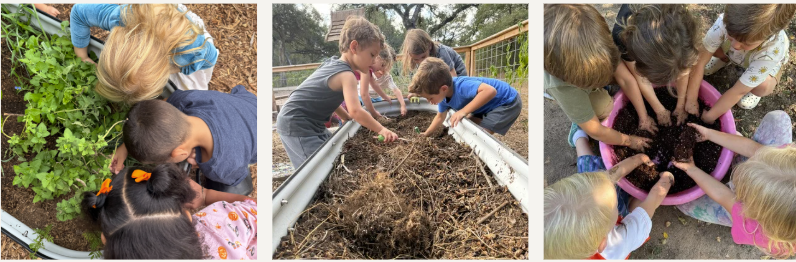
“I have found that in his development, the child passes through certain phases, each of which has its own particular needs. The characteristics of each are so different that the passages from one phase to the other has been described by certain psychologists as 'rebirths'."
Maria Montessori, Four Planes of Education
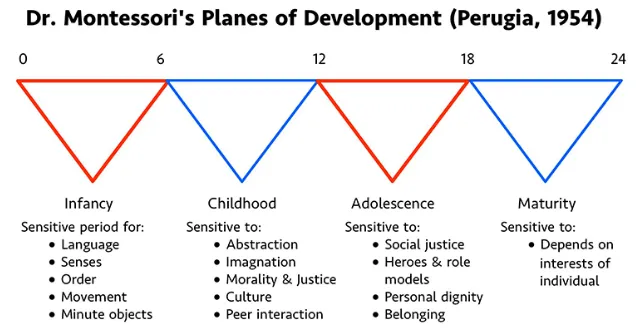
Maria Montessori described human development as the constructive rhythm of life. Anyone who is a caregiver knows from experience that development does not move in a straight line. Rather, there are periods of rapid growth and periods of rest, periods of progression and periods of regression, periods of chaos and periods of calm. New skills emerge and bring disequilibrium, then are integrated and restore balance. Montessori described this cyclical dance as one of creation and crystallization. Through observation, Maria Montessori elaborated a holistic framework of human development that considers the biological, social, emotional, cognitive, and moral changes which occur between 0-24 years of age.
The Four Planes of Development are divided into six-year periods, or planes. The first and third planes are defined by rapid synaptic growth and neural proliferation (creation). In early childhood this is called synaptic exuberance – and, wow, is it exuberant! The second and fourth planes are defined by the coalescence of these new skills, the pruning of less used neural pathways, and myelination of regularly used pathways (crystallization). They are periods of relative calm. Each plane is further broken down into three-year sub-planes, and Montessori classrooms are organized around these three-year cycles.
THE FIRST PLANE / Birth – 6 years old
“Help me do it myself.”
The First Plane of Development is the period of greatest synaptic growth of a person’s entire life. This period of early childhood is defined by what Montessori calls the absorbent mind. From 0-3, the child unconsciously absorbs everything around them, creating both language and movement from nothing. From 3-6, the child begins to explore their environment with more consciousness, though learning is still effortless and spongelike. Montessori observes that “the hand is the instrument of the mind,” and children during this period need the freedom to move, to explore, to experience the world tangibly – through the hands and the senses. They must be free to act spontaneously and make independent choices.
Early childhood includes sensitive periods where these little minds are primed to acquire language, movement, order and sensory information. The environment must be prepared to offer developmentally appropriate experiences in each of these areas so that the absorbent mind can do its thing! All that synaptic growth means the brain is wiring itself based on the experiences (or lack thereof) within the child’s environment. The outcomes of this period are adaptation to the environment and self-construction. It is a period of maximum effort, parallel play, hands-on learning, and functional independence.
THE SECOND PLANE / 6 – 12 years old
“Help me think for myself.”
When the child moves into the Second Plane of Development, they experience their first rebirth. The child’s transformation is defined by the shift from the absorbent mind to the reasoning mind. Often caregivers feel as if they have a completely new child! The reasoning mind allows the child to think abstractly, to imagine beyond that which they can touch and see. They are entering a period of relative physical calm but there is a great intellectual expansion. The imaginative mind asks big questions and grasps abstract concepts like, how long ago was the beginning of earth? They are interested in understanding the world, there is no question too big!
During this period, the child’s psychological center moves outward, and their priorities become social and moral. They are deeply invested in justice and hero worship. Relationships are everything; learning is collaborative and social organization emerges. Kids are developing an awareness of the interconnectedness of life and asking what their role is within it. Maria Montessori developed the Cosmic Education curriculum in an effort to truly give them the universe and guide them as they understand their own cosmic task.
THE THIRD PLANE / 12 – 18 years old
“Who am I?”
Maria Montessori described the adolescent as a social newborn. This newest rebirth signifies the end of childhood and the beginning of adulthood. They are now entering another phase of creation, transformation and instability. Not only is this stage the second greatest period of synaptic growth of their life, but it is also the onset of puberty, and the adolescent is experiencing enormous physical and hormonal change. They desire independence from adults and seek to establish their social identity among their peers, yet still depend upon adults in many ways. This phase is characterized by physical, mental, social and emotional tumult, as the parent of any t(w)een well knows! In the face of this great transformation, Maria Montessori developed the idea of the Erdkinder.
The adolescent, in this turbulent period of creation, seeks valorization – a growing self-worth built on a sense of purpose and contribution within their community. The Erdkinder is a farm school and often a boarding school. It is a prepared environment where the adolescent can learn to live cooperatively, practice caretaking (of land, animal, self, peer), participate in the farm microeconomy, learn art and trades from experts, and continue their academic studies as they further orient themselves as social individuals in the world.
THE FOURTH PLANE / 18 – 24 years old
“What will I do?”
This period of young adulthood is one of relative stability and the crystallization of skills acquired in the third plane. The young adult’s physical and neurological growth is nearing completion. This stage of development aligns with the period when many young adults are entering into spaces of higher education and/or learning specialized trades. They are exploring their values, establishing financial independence, and seeking their greater purpose. Young adults are motivated to find meaningful work and wondering what their contribution to society will be. They are focused on developing spiritual, moral and economic independence. This is the last period of development outlined in Maria Montessori’s Four Planes of Development.
When we understand the stages of human development and the specific needs and outcomes of each stage, we can create appropriate and supportive environments. Young people will move through these developmental stages no matter what environment they find themselves in, but the outcomes will be vastly different based on the quality of that environment. We often use the metaphor of healthy food versus junk food. A child will eat whatever is available, but the results will be immensely different depending upon what was consumed. In Montessori education, each three-year-cycle has a meticulously prepared classroom (the tangible environment) with educators who are trained to understand the child’s specific developmental needs (the intangible environment). In this way, we are able to offer young humans the healthiest of foods at each stage of their developmental journey.